What the Research Says: Social Dilemmas in the Local Energy Transition
By Eve L. Castille
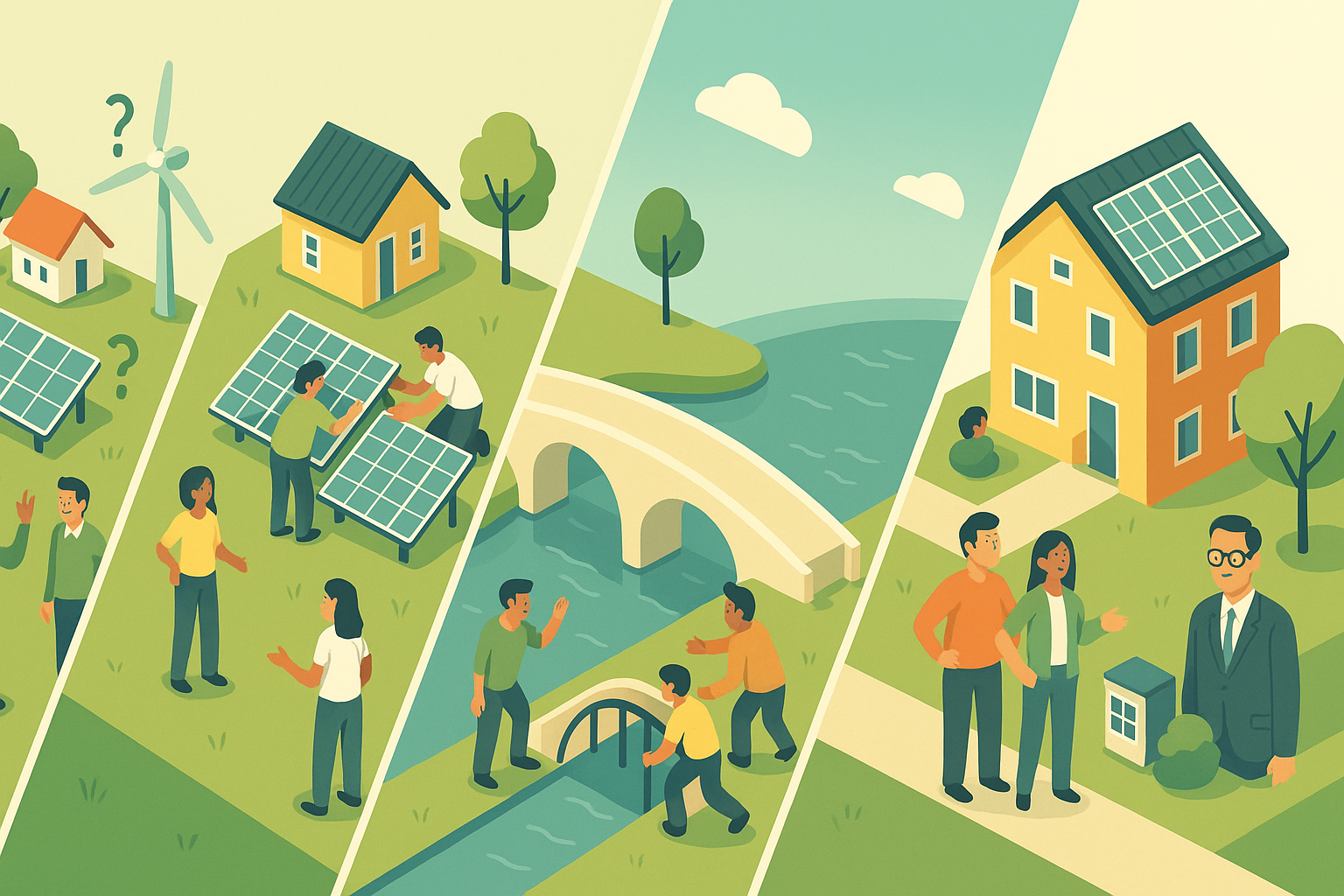
Germany’s energy transition won’t succeed without meaningful progress at the local level. But while many communities want to act, they’re often held back by what social scientists call social dilemmas—situations where acting alone seems risky, costly, or unfair, even when everyone would benefit from acting together.
What This Means for You
If you’re a public administrator or utility planner, this research points to two key takeaways:
- Don’t wait for others to lead. If everyone defers action, the transition stalls. Leadership and cooperation pay off—especially when trust is built through inclusive processes.
- Design for collaboration. Success often depends not on a single actor’s capacity, but on how well multiple actors coordinate. That includes governments, utilities, developers, and community groups.
Tools like joint planning frameworks, benefit-sharing schemes, and structured participatory processes aren’t just “nice to have”—they’re critical for overcoming structural social dilemmas.
So, what do we actually know about these dilemmas from existing research?
To find out, we conducted a systematic, AI-assisted literature review. The goal was simple: scan the global peer-reviewed literature for real-world cases where social dilemmas arise in renewable energy transitions—then understand where and how they’re addressed. The literature review was limited to English-language, peer-reviewed literature and reports on what we could learn from the abstracts. Our approach was designed to paint a picture of the research; it is not exhaustive.
This article summarizes our key insights. Spoiler: wind projects dominate the debate, siting issues are the most studied, and heat systems and financing challenges are still underexplored.
What We Looked For—and How
We searched across multiple energy sectors—wind, solar, bioenergy, grid infrastructure, and district heating. The central question was: Where have researchers identified social dilemmas, and which types are most common?
Using Scopus, a major academic database, we filtered for English-language peer-reviewed articles published since 2010. To capture relevant studies, we included keywords covering:
- Energy technologies (e.g. “wind”, “solar”, “district heating”)
- Social dilemmas and collective action (e.g. “free rider problem”, “NIMBY”, “coordination failure”)
- Local governance (e.g. “municipality”, “town”, “city”)
The result? 901 articles—far too many to read manually. That’s where AI came in.
AI-Assisted Screening
To quickly identify the most relevant studies, we used a Python tool called ASReview, which applies active learning to streamline literature reviews. As we manually coded abstracts for relevance, the algorithm learned to prioritize the most promising ones.
After reviewing 319 abstracts, we found 103 relevant articles dealing with social dilemmas at the local level. These focused on real-world coordination problems—not just attitudes or perceptions—and spanned multiple energy sectors.
What Did the Research Say?
We categorized the articles using AI tools and manual coding to identify which dilemmas appeared most often. Here’s what we found:
1. Siting Dilemmas Dominate
The most commonly discussed social dilemma was the siting dilemma—where local subgroups bear the costs of a renewable project (e.g. noise, aesthetics, land loss), while benefits go to others. Out of the 30 articles we deeply coded:
- 22 discussed siting dilemmas
- Mostly tied to wind energy, followed by solar, biogas, and grid
These dilemmas are often linked to community resistance, especially when people feel left out of planning or decision-making. For example, when there is a high concentration of wind projects where the conditions are favorable. Procedural justice, fairness, and compensation mechanisms are crucial here.
2. Free Rider Problems Are Rare—But Real
Only three articles clearly described a free rider problem, where municipalities benefit from others’ investments in renewables while avoiding costs themselves. For example, solar community residents do not contribute to solar microgrid maintenance expecting someone else to do it.
These were often found in cases of shared infrastructure or regional targets, where no individual town feels responsible for initiating investment—especially in the absence of external pressure.
3. Assurance Games Show Up in Collaborative Settings
We found five cases of assurance games—where large or risky investments only make sense if multiple actors commit together. This is especially common in:
- Joint wind projects
- Community-led bioenergy
- Rooftop solar requiring industrial building access
- Heat grid transitions
These situations highlight the importance of trust, coordination, and trial projects to de-risk decisions. For example, a costly biomass energy project may not be built without trust in nearby industry to provide fuel for the plant.
4. User-Investor Dilemma Is Surprisingly Absent
Strikingly, none of the abstracts clearly identified a user-investor dilemma—where one party invests, but another benefits. A common example of this is the tenant-landlord dilemma, where improvements to the apartment benefit the tenant but are paid for by the landlord. We suspect this might reflect a gap in keyword coverage (we may have missed relevant studies) or a blind spot in the academic literature. For example, in our experience this debated in tenancy law or related to financing models. Our search focuses on coordination and collaboration challenges.
This is surprising, given how often utilities or municipalities invest in infrastructure that primarily benefits others—like household PV integration or shared heating networks.
Beyond Categorization: What Factors Shape Outcomes?
To go deeper, we used a language model to extract cause-and-effect patterns from the abstracts. After cleaning and grouping the data, we identified over 70 contextual factors that influence success or resistance in renewable energy transitions. Some highlights:
- Awareness & Benefits: Media coverage, perceived economic benefits, and youth training helped build local support.
- Community Attributes: High civic engagement, education, cohesion, and prosocial values foster cooperation.
- Costs & Risks: Aesthetic concerns, grid compatibility, biodiversity threats, and return on investment all shaped attitudes.
- Governance & Trust: Shared vision, public participation, and trust in utilities or developers were key to success.
- Procedural Justice: Fairness, transparency, and inclusion in planning processes played a decisive role—especially in siting conflicts.
These findings confirm what practitioners already sense: technical feasibility is not enough. Social acceptance, procedural fairness, and collaborative governance are equally vital.
Reflections and Gaps
Our review surfaced a few important lessons for researchers and policymakers:
- Siting dilemmas are well-covered—but often treated as „acceptance“ issues rather than collective action problems.
- Heat and user-investor dilemmas are underexplored—despite their practical relevance in local infrastructure planning.
- Very few studies explicitly use the term “social dilemma,” even when describing them. This may hamper knowledge sharing across sectors.
- Trial projects—demonstrating feasibility and shared benefits—emerge as powerful tools to overcome both siting and assurance dilemmas.