E-SKA Has Successfully Launched!
A significant part of the energy transition takes place at the local and regional level, where buildings are being renovated, power grids expanded, and renewable energy generated and supplied. The role of municipalities will continue to grow in importance in the years ahead.
100% renewable energy regions, solar cities, master plan municipalities, and other pioneering communities have already developed successful solutions to the many challenges of the energy transition at the local level, often in collaboration with a wide range of stakeholders. Other municipalities, however, are still at an earlier stage of this process. This raises the important question of how successful approaches can be scaled up and transferred more broadly across regions and communities.
E-SKA is a research project conducted by adelphi research, the Resource Economics Group at Humboldt University of Berlin, Difu, and ASEW. The project is the first to systematically identify and analyze the mechanisms and success factors that help overcome barriers to local energy transition initiatives. Building on these insights, we are developing and testing a novel archetype-based approach for transferring successful energy transition collaborations to other municipalities facing similar challenges and conditions. As part of the project, we are establishing a database of successful energy transition cooperation examples, supporting the development of an AI-assisted transfer approach, conducting scalability assessments, and facilitating the practical application of project results.
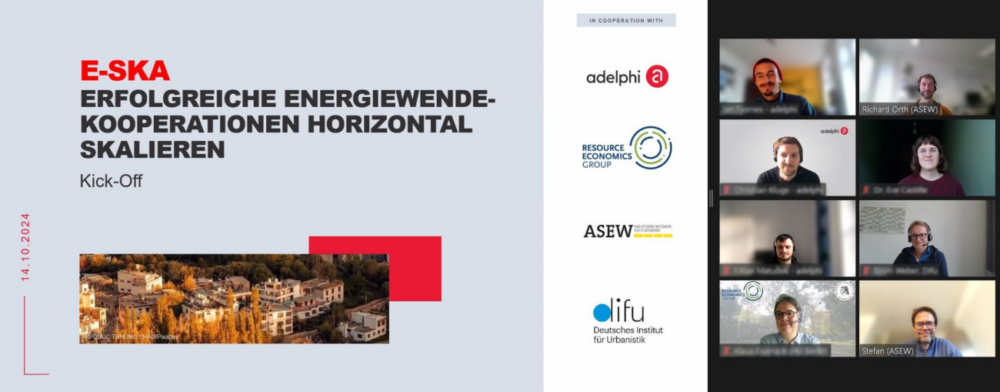
The project successfully launched in October 2024 and will run until September 2027. Our official kick-off took place on Monday, October 14, 2024. (LinkedIn-Post).
In the coming months, we will begin the foundational phase of the project and launch a machine learning-supported systematic literature review to identify the social dilemmas associated with the local energy transition. In addition, we will start a policy analysis to examine the role that policy instruments currently play in Germany in the emergence and resolution of such dilemmas.
Starting in 2025, we will be looking for pioneers of successful intra- and inter-municipal energy transition collaborations that are suitable for comparative case studies. Through these case studies, we aim to examine in greater detail how and why these collaborations emerged, which factors contributed to their success, and to what extent their development and success (or failure) are systematically linked to local contextual factors.