Data-Driven Research: Database on Energy Transition Factors in German Municipalities
Understanding how the energy transition is implemented at the local and regional levels in Germany requires insight into the level at which this occurs: the municipalities.
ESKA examines, among other things, how pioneer municipalities or regions have succeeded in implementing their energy transition projects. However, an even more crucial aspect of the project is determining how the approaches of successful municipalities can be expanded to other regions, or how cooperative approaches can be scaled.
How can understand what is happening at the municipal level at scale?
To assess the current status of renewable energy expansion and identify other key factors at the municipal level, we consult (mostly publicly) available data. However, this presents several challenges:
- The data landscape is highly fragmented and incomplete.
- Published data is often narrowly focused on specific topics and available only through certain administrative agencies.
- Data corresponds to different administrative levels, such as the state, district, or municipal level.
- There is no single data source that publishes all information in a consolidated form.
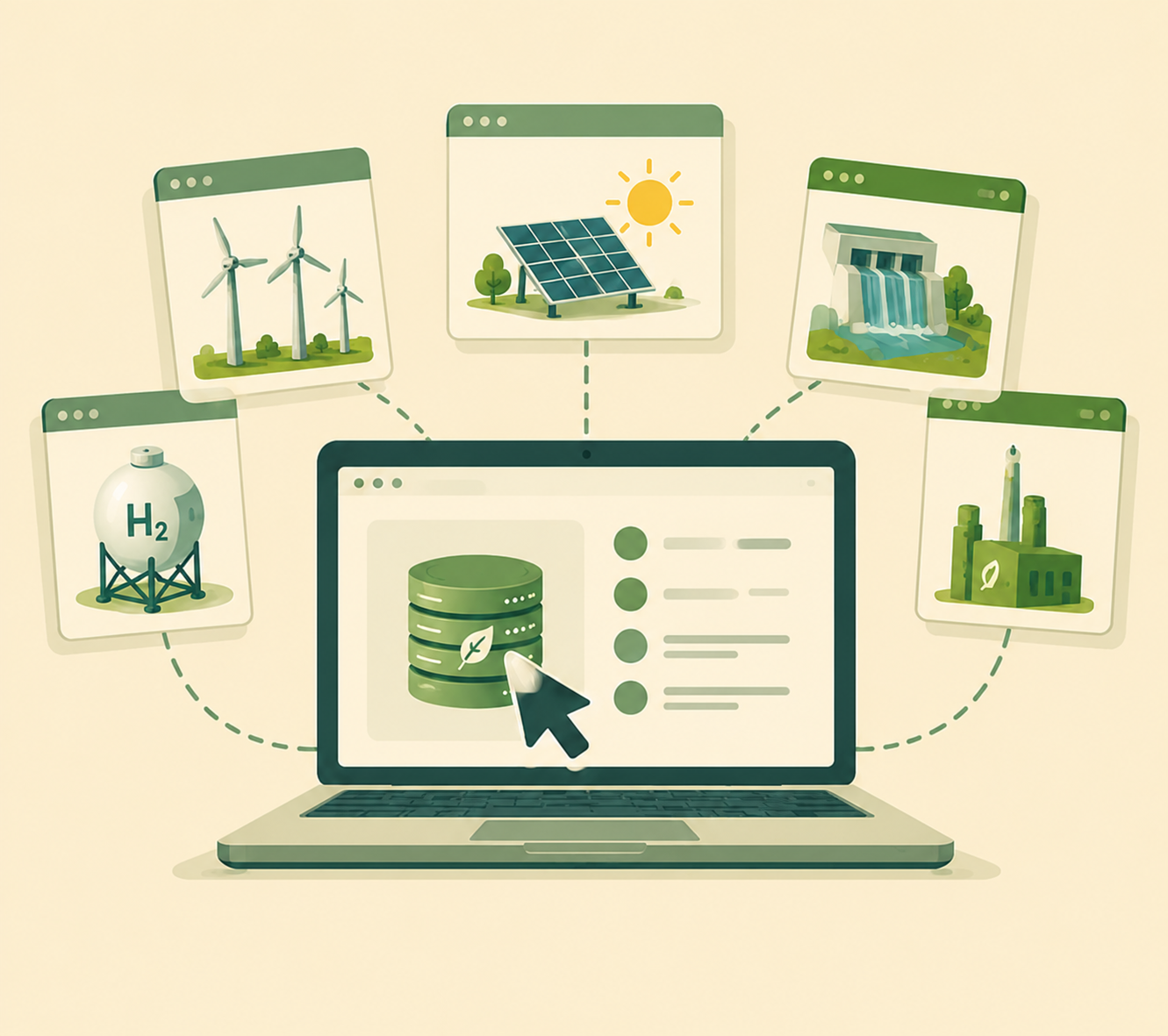
We have identified this gap and therefore created our own database covering all approximately 11.000 municipalities. In this blog post, we aim to explain the structure of the database and demonstrate which data sources were utilized.
For Practical Application – Where Can I Find Suitable Data?
If you are searching for older data regarding your municipality, you may encounter various obstacles, for instance, if names or responsibilities have changed over time. As the territorial structure of the Federal Republic of Germany is subject to continuous change, municipal and district boundaries are redefined, locations are split off, municipalities are dissolved, and names are altered. This also leads to changes in municipal identification numbers and codes.The Federal Statistical Office publishes territorial changes at regular intervals.
ESKA Database in the Profile
We use the reference tables on spatial divisions provided by the Federal Institute for Research on Building, Urban Affairs and Spatial Development (BBSR) as our base frame. Based on data available as of 2024, we account for 10.956 municipalities. This dataset also includes important administrative identifiers, such as the Official Municipal Code (AGS), the Official Regional Code, the District Code, as well as information on the administrative seat, administrative level, electoral district, area, and population. Due to the variety of identifiers, it is also possible to work with several different data sources, as publicly accessible data do not consistently use the AGS in its full form. To incorporate other data, we therefore use this base frame to match data from other sources with the administrative identifiers and add new data to the database. This process is done using a pipeline that processes, combines, and transforms various datasets into usable variables.
The various variable types are:
- Identifiers and administrative levels (NUTS-3, district level, federal state, East/West)
- Population, age structure, migration
- Employment, income, unemployment
- Educational qualifications (at multiple spatial levels)
- Land use and rurality
- Renewable energies: installed capacities by operator and five-year period, solar/wind potentials, municipal heat planning
- Citizen initiatives regarding energy projects
- Local, state, and federal election results 2008–2025
Thus, we have information on over 830 variables for each of the approximately 11.000 municipalities.
What is the AGS?
The Official Municipal Key (AGS) is an eight-digit number sequence that is uniquely assigned to each German municipality and issued by the statistical offices of the Federation and the Länder. The first two digits denote the federal state, the following three the district, and the last three the municipality itself – similar to a postal code, but actually administratively binding.
Where can one find information on the expansion of renewable energies?
A distinctive feature of our database is the utilization of data from the Market Master Data Register (MaStR), a public register maintained by the Federal Network Agency, in which all energy generation facilities and energy consumption units in Germany have been required to be recorded since 2019 -from private rooftop solar systems to offshore wind farms. This register contains data points for all electricity generation units across all energy sources in Germany – totaling over 7.7 million (as of 2025)!
The data is freely accessible and includes, among other details, location (at the municipal level), energy source, operational status, commissioning date, capacity, site, plant operator, and further technical specifications.
While processing such a vast volume of data is technically very complex, it enables an almost complete reconstruction of the temporal and geographical structure of the expansion of renewable energy expansion. Based on our database and the Market Master Data Register, we were able to precisely determine the production volume of renewable energy sources at the municipal level for each year and each energy carrier.
Why are these data of interest?
The integration of data regarding the expansion and status of energy production in Germany can be of interest to various stakeholders and analyses. On the one hand, it enables research into which municipal structural characteristics promote the expansion of renewable energies, or what role citizen initiatives play in municipal heat planning. Furthermore, linking election time-series data with energy capacities in five-year periods allows for the exploration of longitudinal analyses.
For practical applications, such as municipal politics and planning, the combination of heat planning status, energy capacities, and citizen participation data can provide a differentiated picture of the maturity levels of the municipal energy transition. For associations and energy cooperatives, it can indicate which types of municipalities are particularly suitable for cooperation models and where further expansion potential still exists.
Can I access this data?
Not at the moment. We need to validate, store, and document the data in a way that it can be understood and used easily. Look forward to our dataset being available by the end of 2027 as part of the ESKA project.