Diversity of Energy Transition Collaborations: Who Collaborates, How, and Why?
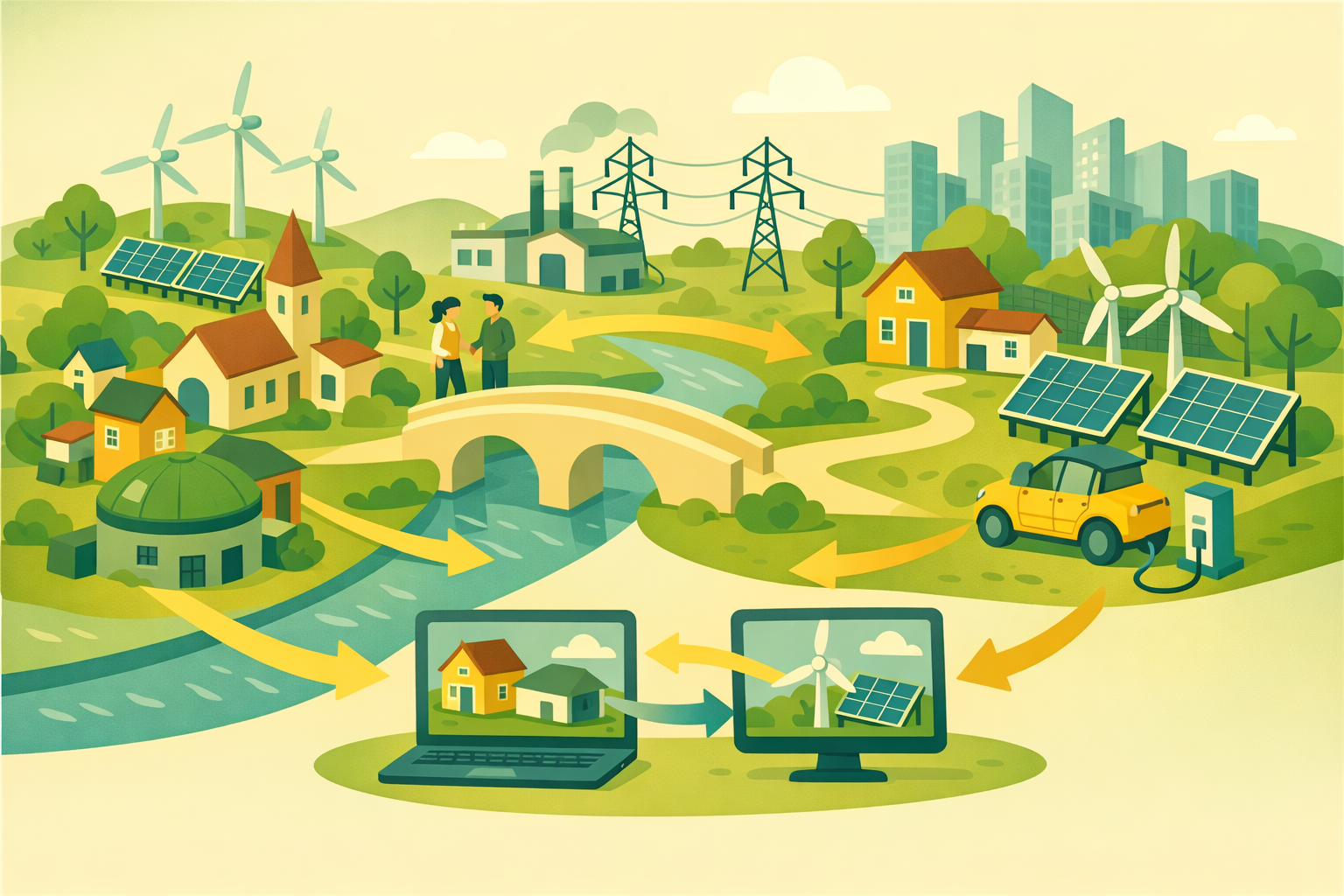
The energy transition is a task that involves society as a whole. But what does collective action look like in practice? Who collaborates with whom – and why? As part of the E-SKA project, we are systematically exploring these questions and have identified a remarkable diversity of forms of collaboration.
What Is an Energy Transition Collaboration?
Before we can describe this diversity, it is important to establish a shared understanding of the term. Within the E-SKA project, we define an energy transition collaboration as a voluntary form of cooperation between two or more municipalities, as well as between municipalities and non-governmental actors, particularly citizens.
To further specify this concept, we draw on the notion of collaborative governance as developed by Ansell and Gash (2008). This refers to a form of collaboration in which public authorities and non-governmental actors jointly and equally participate in decision-making within a structured and consensus-oriented process. Rather than a public authority making decisions while merely consulting others, all participants actively contribute to shaping the process.
For the E-SKA project, we operationalize this framework as follows: We consider an initiative to be an energy transition collaboration if it
- is initiated or co-initiated by a public authority or institution,
- is formally organized, either through a legally established structure (e.g., a special-purpose association or cooperative) or as an informal network,
- makes decisions jointly and through deliberative processes, involving genuine negotiation and collective decision-making rather than unilateral directives,
- establishes explicit or implicit rules for collaboration or creates new organizational structures, and
- has a clear operational focus on the local energy transition, for example through the planning, financing, or implementation of specific projects.
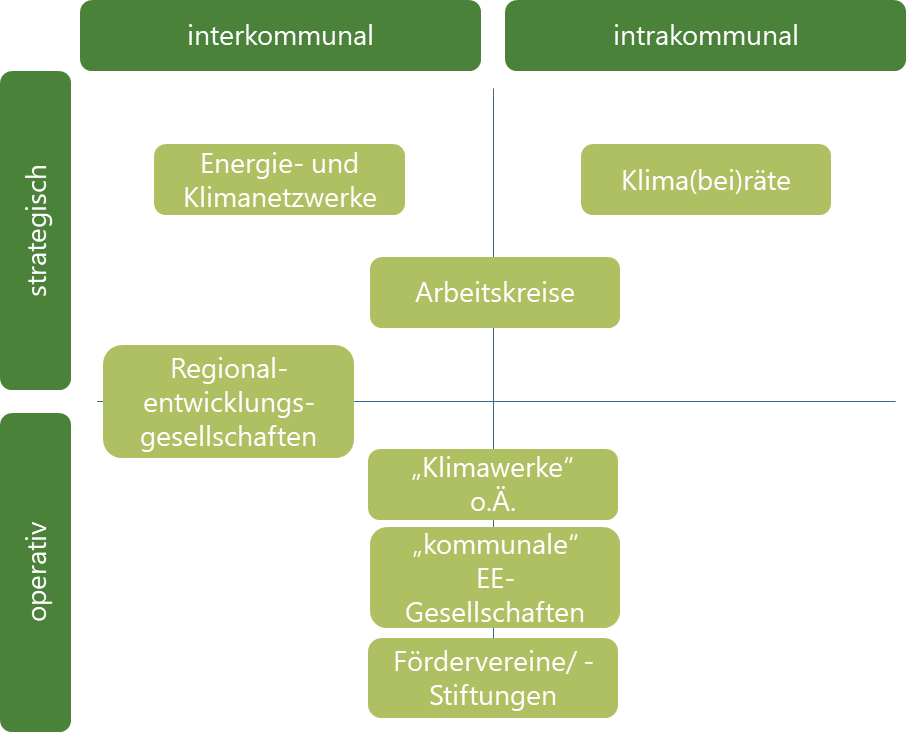
These collaborations may be strategic in nature (e.g., joint policy frameworks or regional climate protection strategies) or operationally oriented (e.g., the development of a shared district heating network). The research focus of E-SKA lies primarily on operational forms of collaboration.
How Did We Proceed?
To systematically capture the diversity of energy transition collaborations in Germany, we analyzed a range of sources. These included initiatives such as 100% Renewable Energy Regions, Bioenergy Villages, and Energy Municipality of the Month, as well as relevant research projects, academic literature, and targeted online research. Based on this analysis, we identified the types of energy transition collaborations that currently exist in Germany and subsequently categorized them within a structured matrix.
What Types of Collaboration Exist?
The categorization shows: that energy transition collaborations can be described along several dimensions, including the types of actors involved, the spatial level at which they operate, and the thematic areas on which they focus.
Who collaborates? The range of actors involved is broad. Collaborations take place between municipalities, between municipalities and citizens, between municipal utilities and private-sector actors, as well as among civil society organizations, agricultural enterprises, housing associations, and energy providers. Intermunicipal collaborations—in other words, cooperation between multiple municipalities—are playing an increasingly important role in planning and implementing energy supply solutions that extend beyond municipal boundaries.
At what level? Collaborations take place across a wide range of spatial scales—from shared district heating networks between neighboring municipalities and regional energy concepts at the county level to cross-state networks and model regions. The spatial dimension shapes not only the scope of impact, but also the governance structures and the question of who formally holds responsibility.
What is being done collaboratively? The range of activities is equally diverse. Some collaborations focus on the expansion of renewable energy, for example through community wind farms or citizen-owned photovoltaic installations. Others concentrate on the heating sector, such as municipal district heating networks based on biomass or waste heat. Still others address energy efficiency, mobility solutions, or the development of local energy markets. In many cases, these fields of action are closely interconnected—for example, when a bioenergy village simultaneously provides electricity, heat, and fuel from local resources.
How are collaborations organized? Finally, energy transition collaborations differ considerably in their formal structures. Some are organized as registered cooperatives, enabling broad citizen participation. Others operate through special-purpose associations, limited liability companies (GmbHs), associations, or informal networks without a formal legal structure. The choice of organizational form has far-reaching implications for liability, financing opportunities, and the democratic participation of those involved.
What Does This Diversity Mean?
The categorization highlights one key insight: there is no single model of energy transition collaboration. Depending on the local context, available resources, political framework conditions, and the commitment of local actors, very different forms of collaboration emerge—and for good reason. A solution that works for a rural bioenergy village cannot necessarily be transferred directly to an urban residential development or an intermunicipal business park.
At the same time, this diversity demonstrates that collaboration is not a niche phenomenon within the energy transition. Across Germany, such collaborations are widespread, institutionally established, and active across a broad range of thematic areas. This is precisely where the E-SKA project begins: we seek to better understand the conditions under which these collaborations emerge, how they function, and what lessons other actors can learn from them.