E-SKA Research Team at the NIÖ Network Meeting – Cooperation as a Key to the Energy Transition
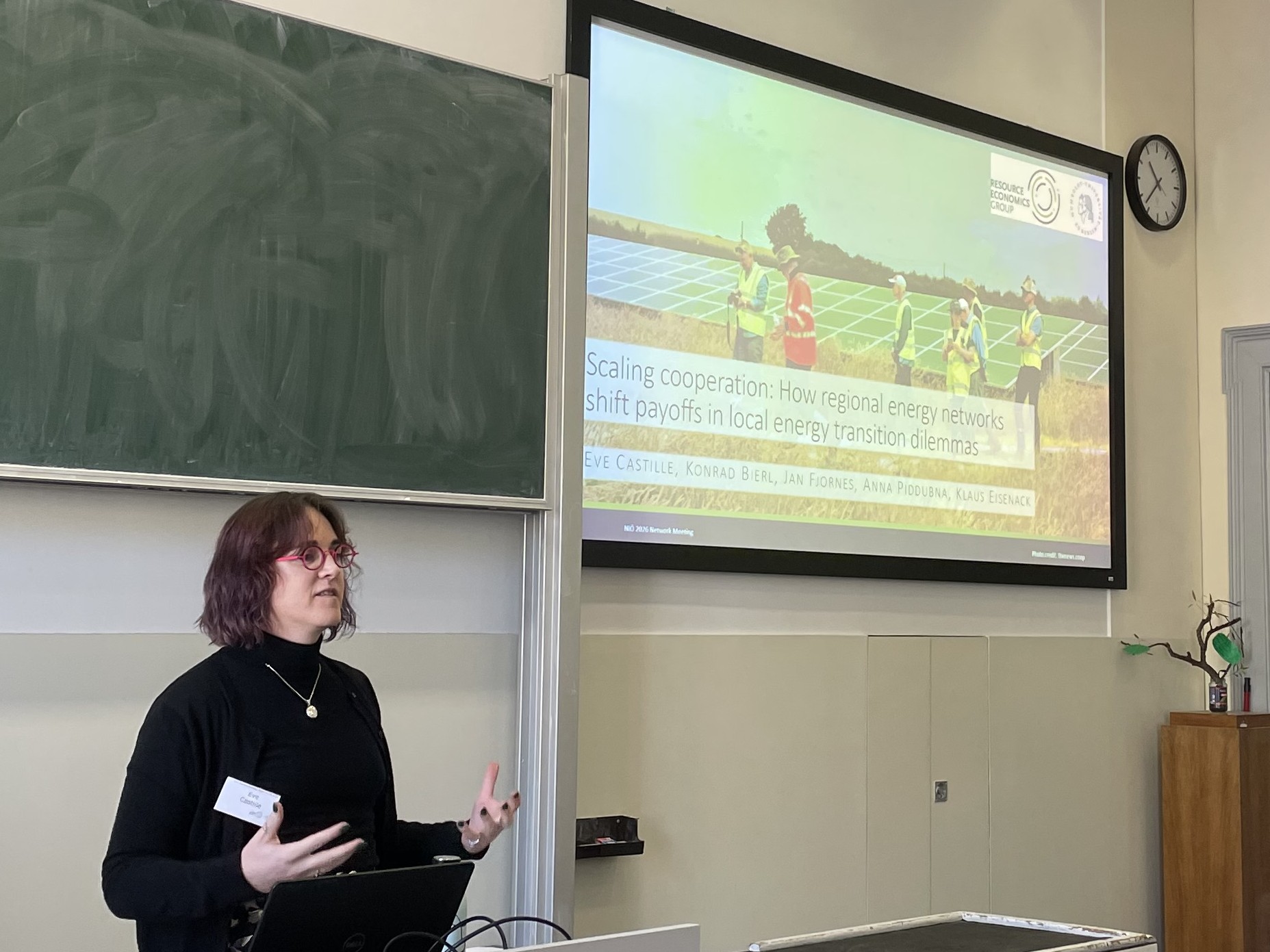
On 17 and 18 March, we participated in the annual NIÖ Network Meeting. The research network has existed for over 20 years around New Institutional Economics (NIÖ) and the concept of „Institutions of Sustainability“. This year’s theme was: „Commons for the (Not) Gentle World: Institutions, Cooperation and the Shifting Political Landscape“.
Our Contribution: Scaling Cooperation in the Energy Transition
The E-SKA project was represented with a research presentation. Under the title „Scaling cooperation: How regional energy networks shift payoffs in local energy transition dilemmas“, Dr Eve Castille presented current findings from the project.
At the heart of the presentation was the question: Under what conditions can social dilemmas in the siting of renewable energy installations be overcome through cooperative strategies?
Cities are major consumers of energy, yet often lack sufficient space for renewable energy installations. Rural areas are therefore increasingly coming into focus – but face complex distributional conflicts between costs and benefits. The research presented draws on the Institutional Analysis and Development Framework (Ostrom 1990) and models this tension as a two-stage game-theoretic model: In the first stage, neighbouring municipalities decide whether to accept renewable energy installations on their territory or to defer to the other municipality. In the second stage, they interact with locally affected residents, who may support or oppose the project.
For empirical validation, data from all German municipalities will be used, including installed capacity data from 1990 to 2024 – supplemented by information on citizen petitions as an indicator of local resistance.
Illustrative case studies – Neue Energien West eG and KERL eG in the Upper Palatinate – demonstrate how regional cooperative structures can shift incentives. Strong institutionalisation and congruent rules (in the sense of the IAD framework) can increase regional value creation, reduce political costs for municipalities, and strengthen public acceptance.
Following the presentation, a discussion with the specialist audience ensued – a valuable exchange at the intersection of institutional analysis, commons research, and energy transition policy.
Key Takeaways:
This research and discussion with specialists reinforced the ideas:
- Scaling the renewable energy transition justly means we need to understand how to mitigate the costs to people living in rural municipalities.
- High costs to an affected population does not always lead to resistance. There is also a cost to fight, which we explore ways to observe such as social cohesion and citizen petitions. Maybe this is not a cost to fight, but rather a degree of social cohesion or history of grassroots organizing.